
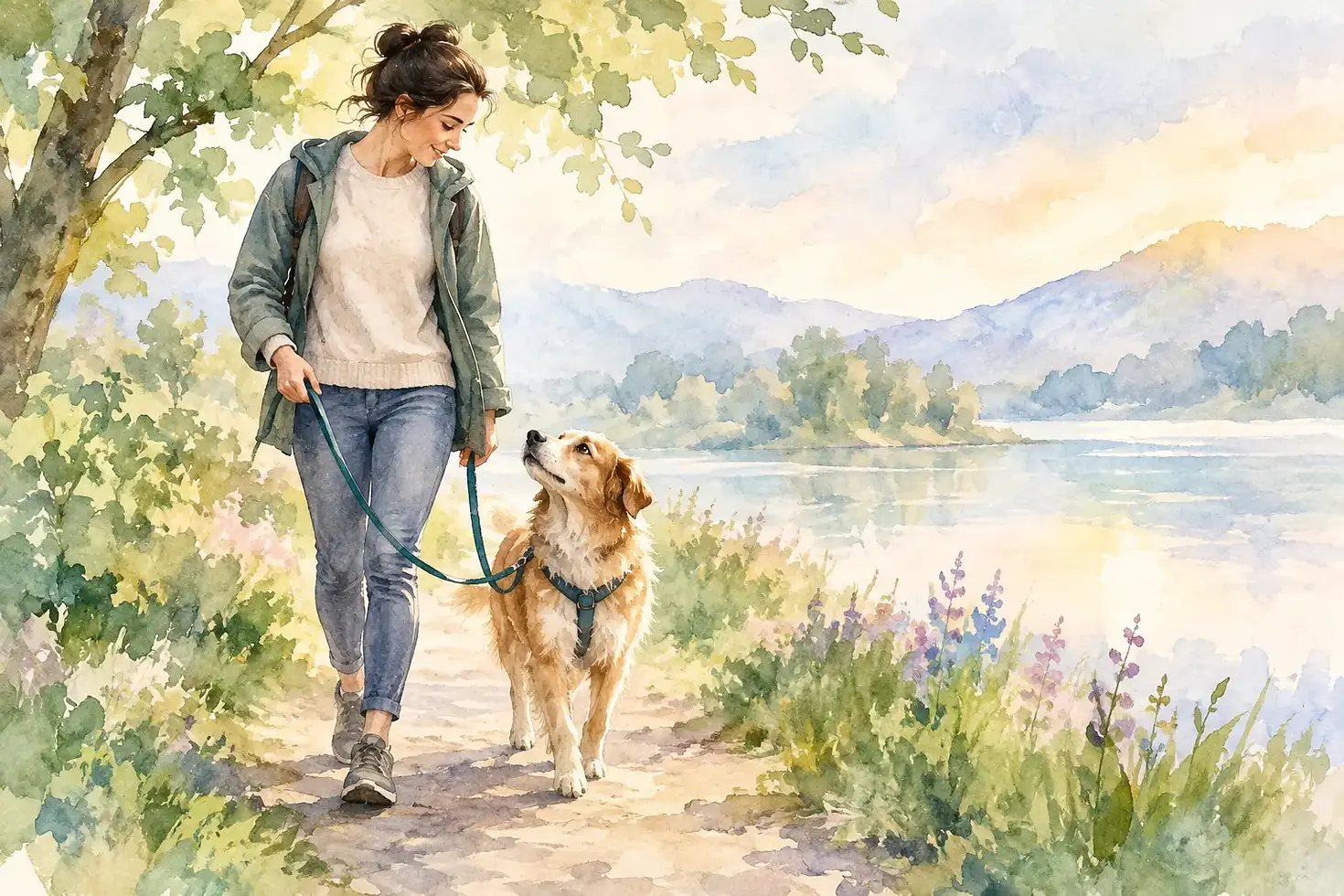
Dog Walking for Anxious Dogs Made Kinder

The walk begins before the leash comes out. For an anxious dog, the sound of keys, a busy hallway, or a dog passing the front window can already feel like too much. Dog walking for anxious dogs is not about covering a certain distance or making a pup tired enough to cope. It is about helping them move through the world with enough safety, choice, and support to learn that they can handle it.
That shift matters. A dog who freezes, pulls home, scans constantly, barks at strangers, or refuses treats outdoors is not being difficult or dramatic. They are communicating that their nervous system is overloaded. The kindest walk is not always the longest one. Sometimes it is ten calm minutes on a quiet block, followed by a peaceful return home.
Why anxious dogs struggle on ordinary walks
A walk asks a lot of a worried dog. There are unfamiliar sounds, unpredictable people, other dogs, vehicles, smells, tight sidewalks, and the pressure of a leash that limits escape. Even a dog who is relaxed at home may find those layers of stimulation exhausting.
Anxiety also does not always look like obvious fear. Some dogs become loud and forward, lunging or barking to create space. Others shut down, walk slowly, sniff compulsively, pull toward home, or seem unable to respond to cues they know perfectly well indoors. Both patterns deserve curiosity, not correction.
This is where generic advice can cause harm. Repeatedly placing a dog close to the thing they fear in the hope they will “get used to it” can flood them. Flooding means the dog is exposed beyond their ability to cope. They may become quieter in the moment, but quiet is not the same as feeling safe. A suppressed response can be mistaken for progress when the dog is actually becoming more distressed.
At Amber's Cottage, we view behavior through relationship, resilience, and science-informed support. The walk is not a test of obedience. It is a shared experience where your dog learns whether you will notice their signals and help them feel protected.
Dog walking for anxious dogs starts with distance
Distance is one of the most powerful tools a pawrent has. If your dog can see another dog across a field, notice them, and continue taking food or sniffing, they may be under threshold. If the same dog appears ten feet away and your dog stiffens, stares, vocalizes, or stops listening, the distance is too small.
Threshold is the point where your dog can no longer process information calmly. Learning happens beneath it, not in the middle of panic. This does not mean avoiding the outside world forever. It means arranging exposure in manageable pieces, then building capacity gradually.
Choose routes with options. A wide sidewalk, quiet cul-de-sac, open park edge, or street with easy turnoffs gives you room to move away without drama. Cross the street early. Step into a driveway. Make a gentle U-turn. There is no prize for passing closely by a trigger when your dog is telling you they need more space.
The goal is not to make your dog ignore everything. It is to help them notice something challenging, remain connected to you, and recover. That recovery may look like taking a treat, looking back at you, shaking off, lowering their body tension, or returning to a relaxed sniff. Those small moments are meaningful data.
Read the signals before the explosion
Most dogs communicate discomfort long before they bark or lunge. Watch for a closed mouth, hard staring, ears pinned back or sharply forward, sudden stillness, a tucked tail, rapid panting when it is not warm, lip licking, yawning, or repeated checking of the environment. No single signal tells the whole story. Look for changes from your dog’s normal body language.
When you see early stress, respond early. Cheerfully create distance, scatter a few treats in the grass if your dog is able to eat, or turn and head toward a quieter area. You are not rewarding fear. You are showing your dog that communication works and that they do not have to handle every situation alone.
Build a walk your dog can predict
Predictability lowers the emotional cost of an outing. An anxious dog often feels better when the walk has a familiar rhythm: the same low-traffic starting route, a few minutes of decompression sniffing, a check-in at a comfortable distance from activity, then home before they are depleted.
Start smaller than you think you need to. A five-minute loop with no big reactions can be more useful than a forty-minute walk full of stress. Keep a simple handwritten or phone note after each outing. Record what your dog noticed, how far away it was, whether they could eat, and how long it took them to settle afterward. Patterns emerge quickly when we stop judging walks as good or bad and begin observing them as information.
Timing matters too. Some dogs do best early in the morning, while others prefer the lull between school drop-off and lunch. If your neighborhood is crowded after work, a shorter potty walk at that hour and a longer decompression outing at a quieter time may be a kinder arrangement. Exercise is valuable, but nervous-system recovery is part of wellbeing too.
Let sniffing do its job
Sniffing is not wasted time or a failure to practice heelwork. For many dogs, scent exploration is regulating. A slower “sniffari” in a low-pressure environment allows a dog to gather information at their own pace and make choices about where to linger.
Use a comfortable, well-fitted harness and a longer leash where it is safe and permitted. Constant leash tension can add frustration and make it harder for both of you to communicate. That does not mean handing over all control. It means balancing safety with enough freedom for your dog to move, investigate, and decompress.
If your dog is too worried to sniff, eat, or move normally, reduce the challenge. Go home if needed. A brave decision is not always to push forward. Sometimes it is to protect your dog’s bandwidth for tomorrow.
What to do when a trigger appears
Despite planning, surprises happen. A loose dog rounds a corner. A truck backfires. A runner appears too close. Your job is not to execute a perfect training routine. Your job is to help your dog get safe.
Move away first. Turn around, cross the street, place a parked car between your dog and the trigger, or step behind a visual barrier. Keep your own voice low and your leash as loose as safety allows. If your dog can take food, offer several small treats as you increase distance. If they cannot, do not insist. Eating is optional, not a performance requirement.
Once you are far enough away, pause only if your dog is settling. A little sniffing, a shake-off, or a soft look toward you can signal recovery. If they remain tense, end the walk or choose a very quiet route home. One difficult moment does not erase progress, but repeated overwhelming experiences can make the next outing harder.
Avoid leash pops, scolding, forced sits near triggers, or demanding eye contact while your dog is frightened. These approaches may interrupt behavior temporarily, yet they can add discomfort to an already scary situation. More importantly, they do not teach the dog what to do with the feeling underneath the reaction.
Progress is measured in recovery, not perfection
An anxious dog may have good days, hard days, and sudden setbacks. Weather changes, pain, lack of sleep, hormonal shifts, a frightening incident, or a string of busy walks can all lower their tolerance. Progress is rarely a straight line.
Look for softer wins: your dog recovers in thirty seconds instead of three minutes; they notice a person at a distance and choose to sniff; they turn with you without pulling; they accept a treat outdoors for the first time. These are signs that their world is becoming more workable.
If fear, reactivity, or shutdown is intense, persistent, or worsening, bring in qualified behavior support and speak with your veterinarian. Pain and medical conditions can influence behavior, and some dogs benefit from a care plan that includes veterinary guidance alongside training. You do not have to carry this alone.
Your dog does not need to love every sidewalk, stranger, or canine neighbor to have a full life. Give them routes that fit, distance when they ask for it, and a human who listens closely. That is how an ordinary walk becomes a small, repeated promise: you are safe with me.


Comments