
Jeryl’s hand crafted 8 ways leash - A little handmade project and tutorial on usage

Updated: May 27
Having worked with dogs for over a decade, one of the tools I’d say I use most would be a leash. A leash for me is not just for walks, but also recall work, grooming and bite prevention when handling aggression cases. Over the years, I’ve gone through more than 20 models, some which were marketed to be designed for challenging dogs that lunges and pulls, others for having functions like hands free option. Understandably, none of them had the right combinations for my work as the functions often comes as a sole highlight for a particular product, meaning I’d have to buy different leashes for different functions. On the contrary, certain designs that seemed like they were meant for training were often way over engineered for the sake of being different, for example shock absorption which was popular in 2010s, actually encouraged some dogs to pull more. I’ve even purchased leashes with seemingly good functions, only for it to be destroyed after leaving it with puppies for a minute, they were often irreparable.
In 2020, as covid was at it’s peak, I decided to go on a short lived journey of designing a leash that actually helps me with my work. While I had a sample made and sold a couple of sets, I eventually stopped this project due to busy schedules. It was too tiring to source the materials, working on building the leashes also took too much time and space. In the end I gave the blueprint to a manufacturer overseas to help build one whenever I needed it for personal use. It cost over $90 to build one for a small dog, which is considered expensive. The quality also got worse each time, with the lack of materials for the improvements needed, I eventually stopped engaging them.
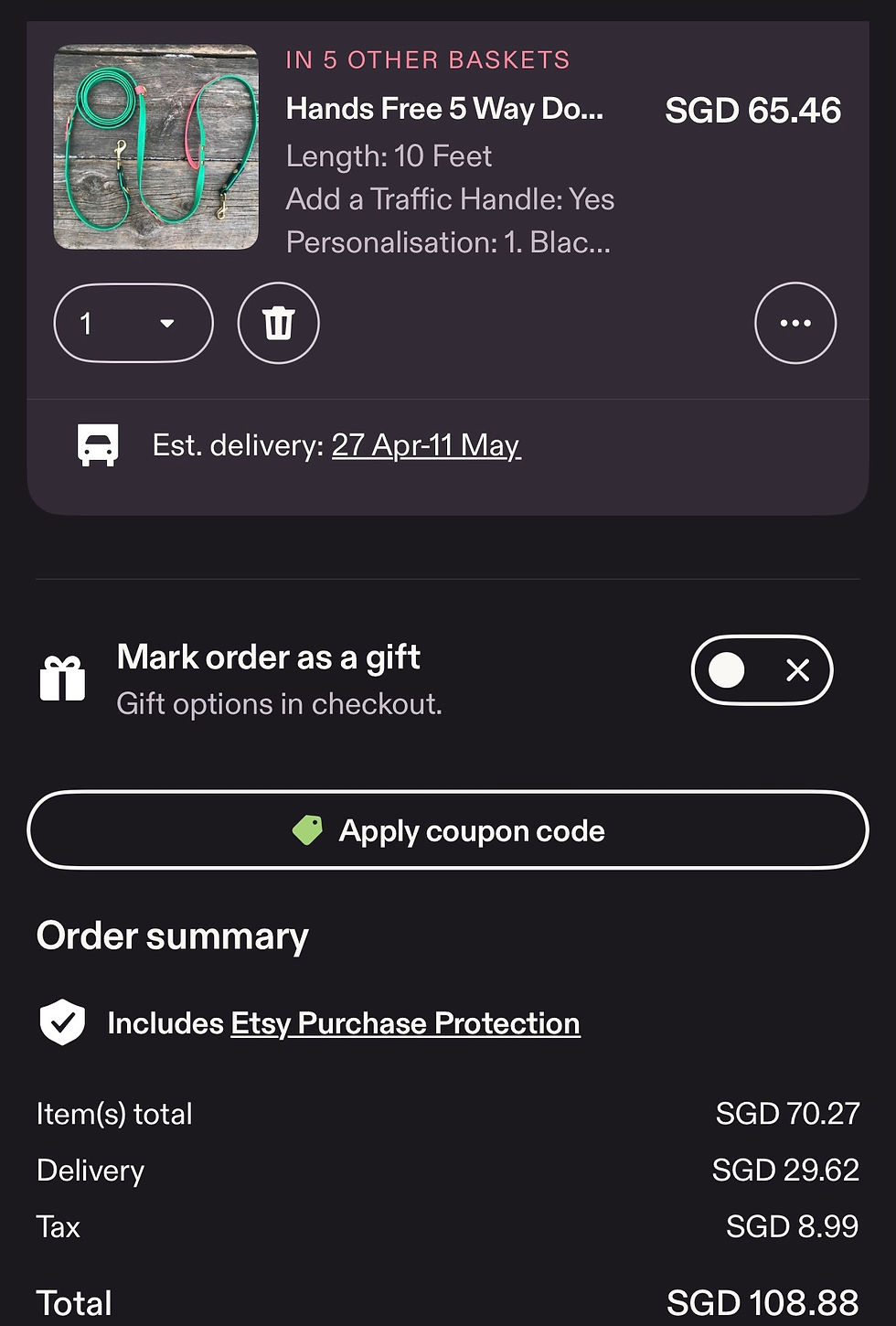
Below is the cost to build one as of March 2026. The price is already more than $100 before upgrading snaps.
Now because my current leash is about to give up, I am personally getting back into the project. Over these 5 years, i was also seeing more areas that can be improved over the initial design.

Here i share my thought process behind this design:
Functions
The functions are designed with the mindset to focus on convenience, safety and practicality in mind. I wanted a leash that can have multiple purposes, works during emergency and also feel confident in my hands. I have a small frame and often have to work with extreme cases, this means that every little detail can make a huge difference. Often, dog owners may have trouble picking up leash handling skills and this impact the speed at which the dog learns, it is very much expected as it takes a lot of time and practice to get the right balance. With this design in combination with practice, it helps minimize mistakes and help dogs absorb the right information, speeding up the process. So it’s not just made for beginners, but also seasoned handlers. On first glance, this leash may look similar to others in the market, you’ll only be able to feel the real difference and benefits once you start using it in actual situations.
I went through a lot of different materials during design process to ensure that it’s not only comfortable, but also durable. The material I picked, which is a different type of biothane, allows better friction on the skin while feeling soft and sturdy in my hands, this makes handling much more intuitive even with beginners. With dogs that charges, a 3cm difference in distance can turn from near miss to full on bite contact, so good friction helps more than most people think. With dogs that pull a lot during walk, this material greatly reduce blisters. I sometimes find myself switching back and forth between using arm strength and finger loop, this is much harder to do with nylon and rope where they are slippery, burns can also happen whenever it slip through hands. FYI, If you are unsure what some of my description means, I can show you when we meet.
I included dual hook which provides 3 different uses. 1. I can walk 2 dogs together, 2. Use both hooks to a point for extra security, 3. Have it on a no pull harness(front and back). For strong/reactive dogs, this leash allows efficient control when both hooks are utilized, your hand should be holding onto the center and allow pressure to be evenly distributed.
Hands free option can be a life saver at times, I decided to incorporate this into the design. I use this for 7 different scenarios. 1. when I need to pick up after dogs, 2. During play time(long leash option is recommended), 3. Sniffing session - single hook on harness/collar while the other end hands free around my wrist, 4. Loose leash training at a later stage, 5. For bigger dogs, I use the long version as a sling around my chest to distribute pressure. While typical hands free function have a fixed size which may not fit smaller builds, my design allows waists as small as you like, this fits even most kids and yet easy on the wrists, 6. To fasten it to a furniture, pole or small tree when needed. As for the 7th scenario, it can also work as a slip leash if you like to use this function on larger dog’s necks, personally I only use it during emergencies.
While most leashes do not have a traffic handle, I included 2 traffic handles for a variety of reasons. First to have emergency control, especially when the dog I’m handling is reactive, as well as danger prone areas such as crossing road, walking past triggers, cyclists, lift etc. For larger dogs, both traffic handles are very comfortable in my hands when the dog’s head is parallel to my waist. Sometimes, when dogs lunge and I can’t find the first handle in time, the second handle can be caught with either hands as the leash lengthen. With dogs that don’t pull as much, I sometimes have a finger looped around either handles in case of emergencies.
New update: All leashes also include additional connection and snap. I’ve added this design after seeing owners struggle with multitasking. This design serves multiple purposes. First, it greatly reduce tripping when your dog is on loose leash, this also adds as additional safety if you want to use the hands free option and yet still have 2 snaps on your dog. Lastly, it only requires one handed control even when both front and back harness rings are utilized, this is a game changer.
Safety & Durability
The main material I use is waterproof and easy to clean unlike typical nylon/rope where it can soak up moisture and encourage bacteria growth, some even smelling bad over time. In my tests, the leash lasted up to 3 years before the material begins to show signs of wear.
This upgraded version of biothane can withstand up to 412kg pull for the large dog model. Being slightly wider at 2cm gives better performance in my experience. Do note however that the break load above refers to the leash material and not hardware, a lot of leash manufacturers do not disclose this. Most snaps out there have a break force of only 40kg, this means that a 5kg dog that pulls a lot can break it over time, especially if the leash material is weak, there needs to be some kind of balance between leash, snap, rivet and rings which is not an easy task. I am very particular about things like these because I am paranoid about safety, so I want you to have the right information.
Very commonly, you’d find leash using hooks in the form of bolt snap. While bolts are cheap and convenient to put on and off your dog, this snap has a huge drawback. It can potentially unlock by itself when the conditions meet, such as when your dog is turning quickly, example during pooping. What happens is the hook gets in contact with the D ring on collar/harness and twists itself open. The second way it can happen is with dogs that love to roll on grass, this happened to me twice in my lifetime and the first time I thought it was a fluke, on the second time it happened I kind of panicked. Over time with dogs pulling, the mechanism can also start leaving wider gaps and spring getting lodged incrementally, this is very difficult to notice until your dog escape from it. I’ve gone through a lot of different snaps and while some are really very secure, they are also very heavy and hassle to put on, this was especially so with carabiner. Hence I decided to use a lobster snap manufactured by reliable sources for the regular leashes, I do also have another heavier option if you prefer. The snaps I’ve used are costly, about $12-$15 each depending on which version. As you can see, one snap is already the price for a market leash, with this you can also imagine the quality with such products. The base hook I use can accommodate up to 426kg of force for large dog model.
The initial self made leash consisted of hardware materials like black zinc and brass. I was leaning more towards zinc overall as the other options left bad smell on my hands after walk. The black zinc had no smell and looked good, however they lasted about 4 months before coating starts camping off. Because of this, I went for stainless steel for at least 90% of the hardware. The reason why it’s not 100% is because for small and medium models, there is no SS material available for the brand of snap I need. SS are more costly as they are much harder to source for the kind of hardware I’m looking at, but the pros greatly outweigh them. SS are naturally harder than brass, it doesn’t rust as easily as other materials and much more hygienic. Maintenance wise making it very suitable for Singapore climate. With visibility, stainless steel offers a very reflective surface which provides better visibility at night. I can see the leash glowing at times and it’s very obvious from far and also beautiful.
The colors of the leash are picked to stand out during walks, but not too much to look out of place. I chose red wine for the base color, and black for alternate areas that would contrast the stainless steel hardware. This makes them even more visible.
For hands free adjustment, I’ve changed from industry standard 1x rivet to 2x rivets. This allows larger dogs to enjoy the hands free function without risking breakage.
The D ring on hands free adjustment is changed from standard to 4mm version. This is rated at 200kg, which is the highest for its size. But for strong pullers, it’s best to use this in conjunction with traffic handle. Together with increased rivets strength, these two combinations will complement each other.
Rivets for hooks are all 3x instead of industry’s 2x. Again making it extra safe, and they glow!
Rivets are also 3x for main traffic handle, while second handle is either 3x or 2x depending on leash model. General guideline for multiple rivets is that they are not just there to make the leash stronger, but also designed to keep the leash intact and usable in the event one of the rivet breaks. And they glow!
Unlike most biothane leash where it’s one piece rolled and fastened, I created a separate three layer support to maximize breakage tolerance, this portion is marked by sub color black.
Price is as listed, with standard and long leash option available.
Dog below 10kg
$69
Dog 10-20kg
$79
Dog 20-40kg
$89
Optional:
Long leash
$10/meter
Once placed, orders will take between 2-4 weeks to complete. We can arrange for either self collection or mail at additional $8.
If you are keen but not ready to commit, feel free to email, pm through our Facebook page or WhatsApp. You can also try out before buying, especially if we have appointments for sessions and about to meet. Just let me know before we meet so that I can bring one sample along.
FAQ
What’s the length between standard and long leash option?
The standard length is 2m. For long leash option, you can choose however long you like for additional $10/m.
Can I change the position of handles?
Yes, I will do my best to accommodate requests, but do be prepared for 1-2 cm difference.
Is there a guarantee on product durability?
While nobody can guarantee 100% on exact durability when it comes to leashes, what I personally believe is decreasing chances of accidents happening by opting for quality materials and proper design planning. If for some reason a rivet comes off, I will be happy to see how I can fix for you. However if the leash is broken into 2, maybe you cut it accidentally or a car ran over it, then there’s not much I can do to save it.
Can I get smaller version if my dog is above the weight limit?
It’s not so much of a weight limit, but recommended based on hardware choice when I build each leash. This is to minimize the chance of breakage. So yes, you can make one for a smaller dog if you prefer to!
Can I order in bulk?
Max 10pcs per order at this stage. Due to the cost of hardware and tools required, the profit margin is only about $20 for a 2 hours project. So this is more of a hobby for me, I’m not planning to make money out of it, it’s more to share my craft so I don’t do large orders. Unless you ready to wait for a couple months, then it’s doable. Do note there’s no discounts.
Can I have other colors?
Currently I have red wine and pink as base color. May consider to increase variants as I clear out the previous stocks.
Comments