
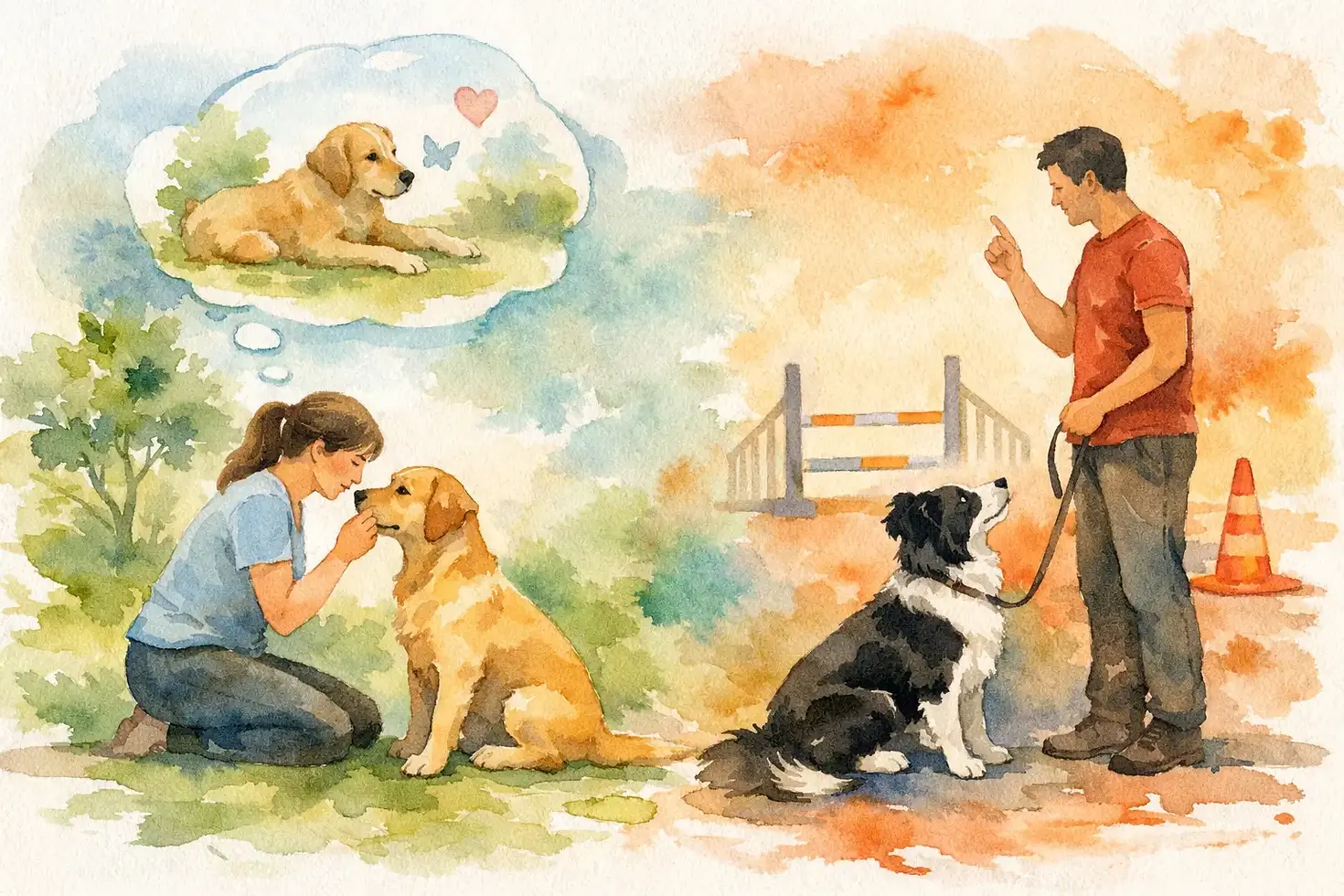
Dog Behaviour Therapy vs Obedience Training

A dog can know “sit,” “stay,” and “come” beautifully in the living room, then bark, lunge, freeze, or shut down the moment life feels too big. That gap is where the conversation around dog behaviour therapy vs obedience training becomes meaningful. One is not better in every circumstance. They simply answer different questions about what your dog needs.
For pawrents who love their furries deeply, this distinction can bring relief. A difficult behavior is not always a sign that your dog is stubborn, defiant, or “bad at training.” Often, it is information. The goal is to read that information clearly, then choose support that protects both your dog’s well-being and your relationship.
Dog Behaviour Therapy vs Obedience Training: The Core Difference
Obedience training teaches skills. It helps a dog learn what a cue means and how to respond under gradually increasing distraction. Think loose-leash walking, coming when called, settling on a mat, waiting at a door, or greeting visitors with four paws on the floor. These are useful life skills, and good obedience work should be clear, kind, and rewarding.
Behavior therapy looks beneath the visible action. It asks why the dog is barking, avoiding, guarding, panicking, lunging, or struggling to settle. Is the dog frightened? Overwhelmed? Protecting space or resources? Rehearsing a response that has worked before? Coping with pain, a major change, limited early experiences, or an unpredictable environment?
The difference matters because a dog cannot reliably perform a learned behavior when their nervous system is in survival mode. Asking a terrified dog to sit near a trigger may create compliance in the moment, but it does not necessarily change the fear underneath. Therapy-focused behavior work aims to build safety, resilience, emotional regulation, and new associations over time.
At Amber’s Cottage, this is why behavior support is not treated as a standard protocol. Each dog brings a history, a temperament, a home environment, and a relationship with their people. Those details shape the plan.
What Obedience Training Does Well
Obedience is valuable, even for dogs with more complex needs. A thoughtfully taught cue can give a dog predictability and give their person practical ways to guide daily life. A reliable hand target can help move a dog away from a crowded sidewalk. A practiced “find it” cue can redirect attention to the ground. A calm settle can make family dinner less stressful.
The best obedience training is not about controlling a dog into silence. It is about communication. The dog learns that a cue is understandable, achievable, and connected to something worthwhile.
Obedience training is often the right primary focus when your dog is generally emotionally comfortable but needs polish, consistency, or household structure. Perhaps your adolescent dog pulls because they have never learned how to walk with you. Maybe your rescue dog is friendly but jumps on guests. Maybe recall falls apart because it has not been practiced in safe stages.
In those situations, clear repetition, smart reinforcement, appropriate management, and owner coaching can make a real difference. The trade-off is that obedience alone may not reach the root of a behavior driven by fear, stress, or past learning.
Obedience should not mean suppression
There is a critical line between teaching a skill and suppressing a signal. Growling, barking, and moving away are forms of communication. Punishing them may make the warning quieter while leaving the discomfort intact. That can make a dog appear more obedient, but less safe and less understood.
A modern, relationship-led trainer helps owners teach alternatives without taking away the dog’s ability to communicate. We can guide a dog to move behind us, go to a safe station, or orient back to their person while also respecting the need for distance and decompression.
What Behavior Therapy Addresses
Dog behavior therapy is appropriate when a behavior has an emotional, environmental, or history-based layer that basic cue practice cannot resolve on its own. This work is usually slower than a six-week manners class because it is not just teaching the dog what to do. It is changing how safe, capable, and supported the dog feels while doing it.
A behavior plan may include careful trigger assessment, changes to routines and environments, management to prevent repeated distress, gradual exposure at the dog’s pace, confidence-building activities, and owner education. In some cases, it should also include collaboration with a veterinarian, particularly when pain, medical changes, or anxiety may be contributing factors.
This is not about labeling a dog as traumatized because they bark at a delivery truck. It is about avoiding assumptions. Some dogs need better leash skills. Some need more sleep and less chaos. Some need help recovering from an upsetting event. Some need a more comprehensive plan that accounts for genetics, early development, health, and learned coping patterns.
A trauma-informed approach pays attention to the dog in front of us. It recognizes that progress may look like a dog choosing to look away, recovering faster after a sound, accepting a treat outdoors, or asking for space before they feel forced to react. Those small moments are not insignificant. They are the foundation of lasting change.
Signs Your Dog May Need Therapy Before More Training
It can be hard to know whether you are seeing a training gap or a behavior concern. Consider behavior-focused support if your dog:
reacts intensely to people, dogs, sounds, handling, or specific places
guards food, toys, furniture, space, or family members
panics when left alone or cannot settle after normal activity
has had a sudden behavior change, especially after illness, injury, or a stressful event
knows cues at home but cannot access them around triggers or outside
None of these signs mean your dog is a lost cause. They mean the behavior deserves curiosity and a plan that goes beyond asking for better obedience.
The Two Approaches Often Work Best Together
The real choice is rarely behavior therapy or obedience training forever. For many dogs, behavior work creates the emotional conditions that make obedience possible. Then obedience skills add practical support to the behavior plan.
Take leash reactivity. A dog who explodes at the sight of another dog may benefit from a well-taught U-turn or hand target. Those are obedience skills. But if the dog is already over threshold, repeatedly drilling cues near other dogs can become frustrating for everyone. The therapeutic piece involves identifying distance, reading early stress signals, reducing rehearsals, building positive associations, and helping the dog recover.
The same is true for separation distress. Teaching “place” may be useful for everyday calm, but it is not a cure for panic when a person leaves. Or consider resource guarding. “Drop it” can be a helpful cue, yet it should not be used to repeatedly take things from a dog who fears loss. The deeper work builds trust around human presence and changes the dog’s expectation of what happens near valued items.
This is where individualized care matters. A generic plan can miss the difference between excitement, frustration, fear, pain, and learned habit. The visible behavior may look similar, but the support should not be identical.
What Good Support Should Feel Like
Whether you begin with obedience lessons, behavior therapy, or a blended plan, you should leave with more clarity, not more shame. Your trainer should be able to explain what they are seeing, what the first priorities are, and what success will realistically look like.
Look for a process that considers your dog’s full life: rest, exercise, enrichment, health, home routines, handling, social pressure, and the patterns that happen before and after a reaction. Ask how progress will be tracked and how the plan will adapt when your dog has a setback. Behavior change is rarely perfectly linear, especially for sensitive dogs.
Owner guidance is part of the work, too. You do not need to become a professional trainer overnight. But your dog needs consistency from the people they trust most. Small adjustments in timing, leash handling, guest routines, or how you respond to early stress can change the picture dramatically.
Your dog is not giving you a hard time. They may be having a hard time, lacking a skill, or trying to communicate with the tools they have. Meet that message with steady guidance, science-informed care, and patience. The goal is never a dog who simply obeys. It is a dog who can move through life feeling safer beside you.


Comments